ParaLin++: Accelerating Parallel Diffusion Integrator
via Intrinsic Partially Linear Structure
Abstract
Training-free few-step samplers are often described as nearly quality-lossless under conventional FID/CLIP-style evaluation. It remains unclear whether that conclusion transfers to more realistic and complex generation-quality benchmarks. We first systematize the quality metrics used to evaluate training-free sampling acceleration for diffusion and flow-matching models. We find that representative step-shortening methods often remain nearly lossless under FID/CLIP-class metrics, yet can suffer substantial quality degradation when evaluated with semantic-composition, dense-instruction, and long-text-rendering benchmarks such as GenEval, DPG-Bench, and LongTextBench. Parallel sampling is a notable exception: by retaining the full-step discretization and removing only the solver’s temporal dependency, it can preserve near-lossless quality while accelerating sampling. Building on this observation, we propose ParaLin++, a step-parity parallel sampler that preserves the full-step discretization while accelerating the solver iterations. Experiments across Stable Diffusion-v2, LSUN Church, FLUX.1-dev, and Ming-Flash-Omni 2.0 show that ParaLin++ preserves the full-step Euler quality profile at 2.6×–4.8×, 1.68× on FLUX, and 1.21× on Ming.
The Metric Gap
The decisive axis of a training-free accelerator is the metric that certifies it “quality-lossless”, not the speed lever it uses. Much of the literature stops at distributional and text-alignment proxies, while generation quality is judged on a broader measurable profile:
📚 What academia reports
- FID / sFID / IS — distribution-to-distribution alignment only
- CLIP score / CLIP-FID — coarse prompt–image embedding similarity
Insufficient for the generation-quality audit: blind to sample-level semantics, dense instructions, and in-image text.
🎯 What generation quality requires
- GenEval — object composition & counting fidelity
- DPG-Bench — dense, multi-clause prompt following
- LongTextBench — long, legible in-image text
FID-Lossless ≠ Generation-Quality Preservation
On FLUX.1-dev, 16-step UniPC / DPMSolver++ can appear close to the 30-step Euler reference under FID/CLIP-style metrics, yet degrade sharply on generation-quality benchmarks. ParaLin++ keeps all 30 discrete steps, parallelizes the solver iterations, and preserves the Euler-level quality while being faster:
| Method | Regime | Steps | GenEval ↑ | DPG-Bench ↑ | LongTextBench ↑ | Speedup ↑ |
|---|---|---|---|---|---|---|
| Euler (reference) | Sequential | 30 | 0.66 | 83.97 | 0.27 | 1.00× |
| UniPC | Few-step | 16 | 0.52 (−21%) | 77.46 (−6.5) | 0.09 (−67%) | 1.81× |
| DPMSolver++ | Few-step | 16 | 0.50 (−24%) | 75.75 (−8.2) | 0.08 (−70%) | 1.85× |
| ParaLin++ (ours) | Step-parity parallel | 30 | 0.64 | 84.24 | 0.26 | 1.68× |
Table: generation-quality audit on FLUX.1-dev. The same pattern holds across guidance strengths (CFG 0–14) and on Ming-Flash-Omni 2.0, where ParaLin++ keeps the Euler-level profile (GenEval 0.87 vs. 0.88; DPG-Bench 86.99 vs. 86.86; LongTextBench 0.95 vs. 0.95) at 1.21×.
See the Difference
Rows: generation-quality benchmarks (GenEval / DPG-Bench / LongTextBench).
Columns: 30-step Euler, 16-step UniPC, 16-step DPMSolver++, 30-step ParaLin++.
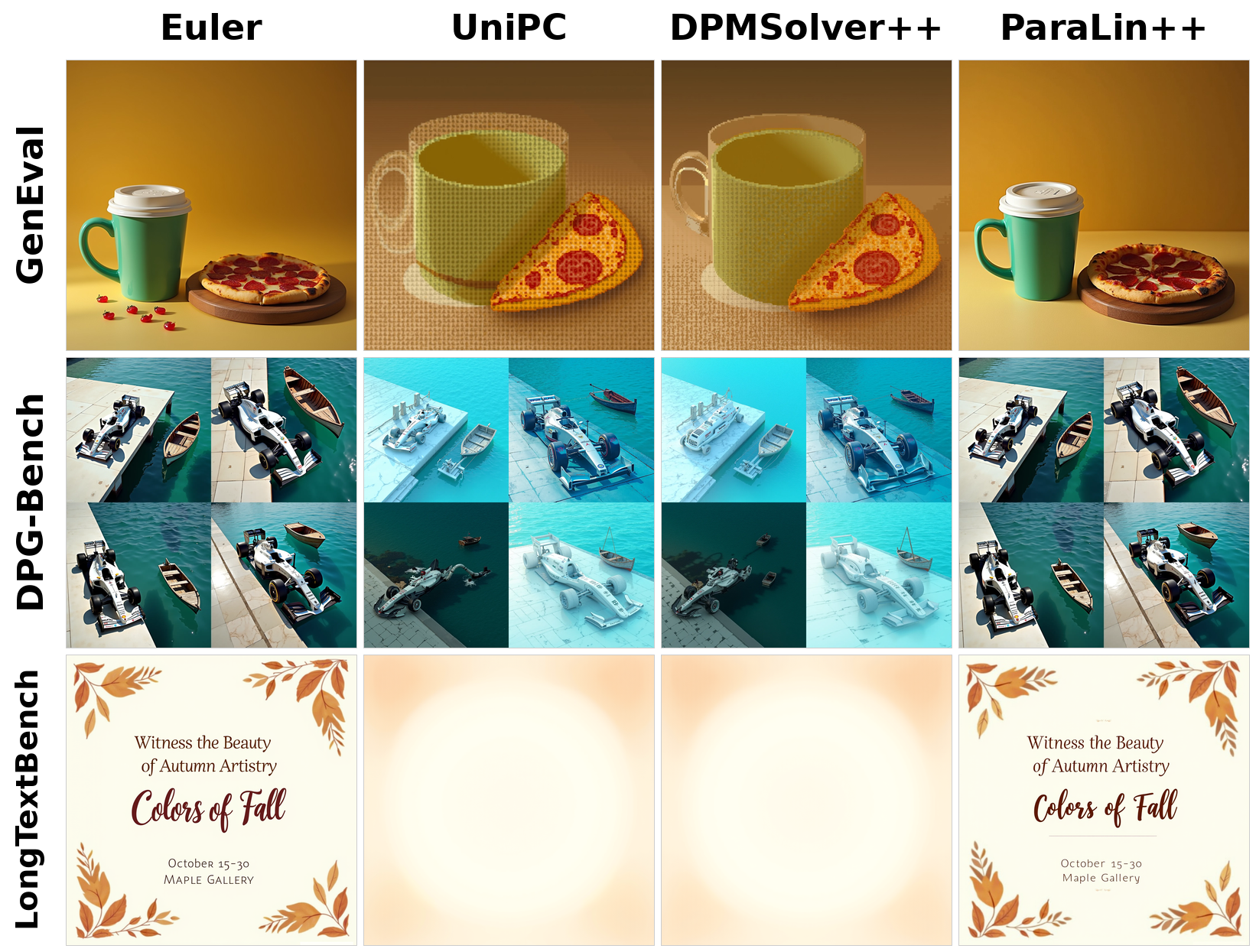
FLUX.1-dev: few-step results keep plausible low-level appearance but break semantics — the pizza gains hole artifacts, the F1 car and boat deform, and the autumn-poster text vanishes; ParaLin++ stays aligned with the Euler reference.
Robust Across Guidance Strengths
Rows: guidance scale (CFG 0 / 3.5 / 7 / 10.5 / 14).
Columns: 30-step Euler, 20-step UniPC, 20-step DPMSolver++, 30-step ParaLin++.
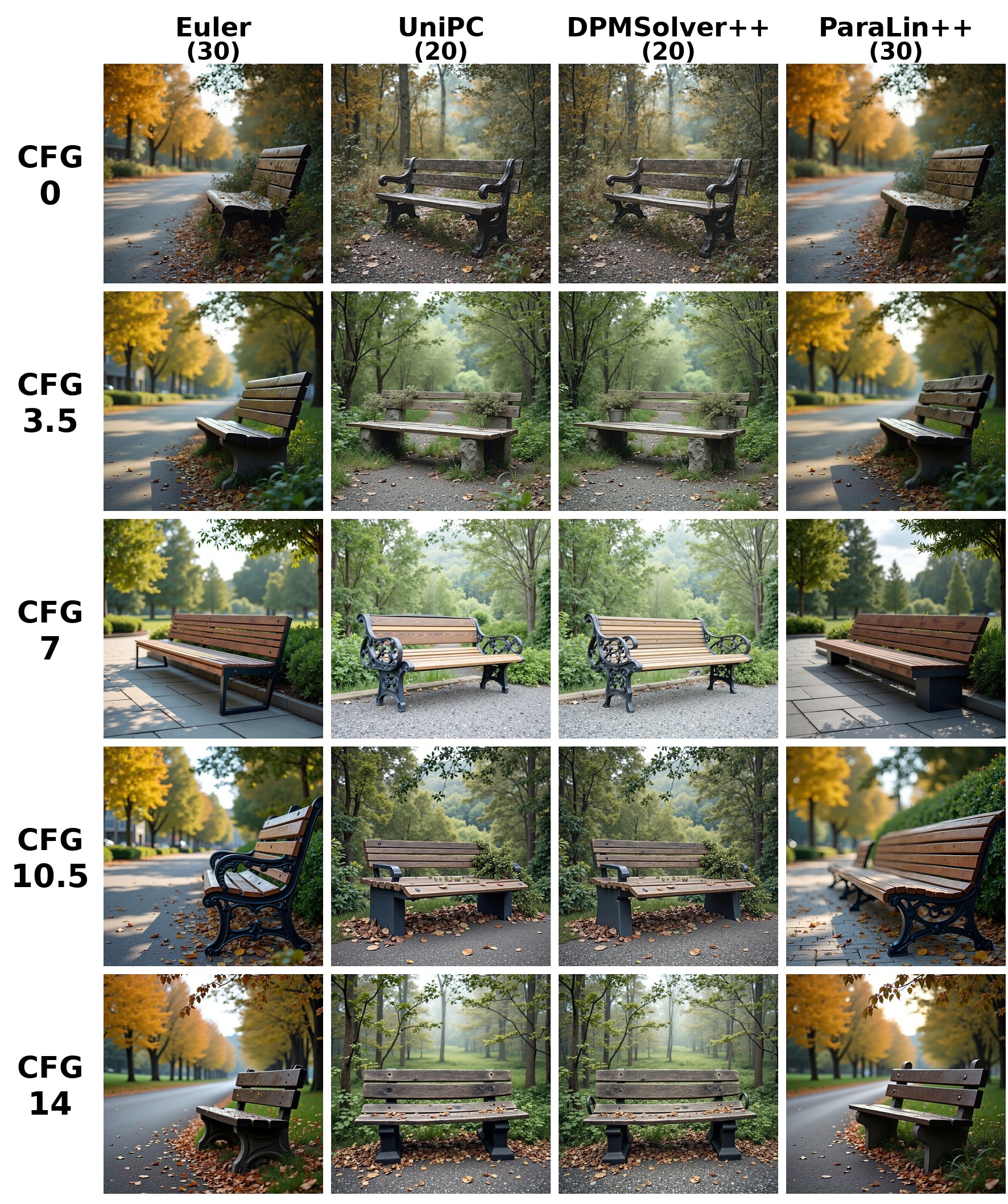
GenEval CFG sweep on FLUX.1-dev: ParaLin++ remains close to the Euler reference while few-step UniPC / DPMSolver++ lose semantic composition as guidance changes.
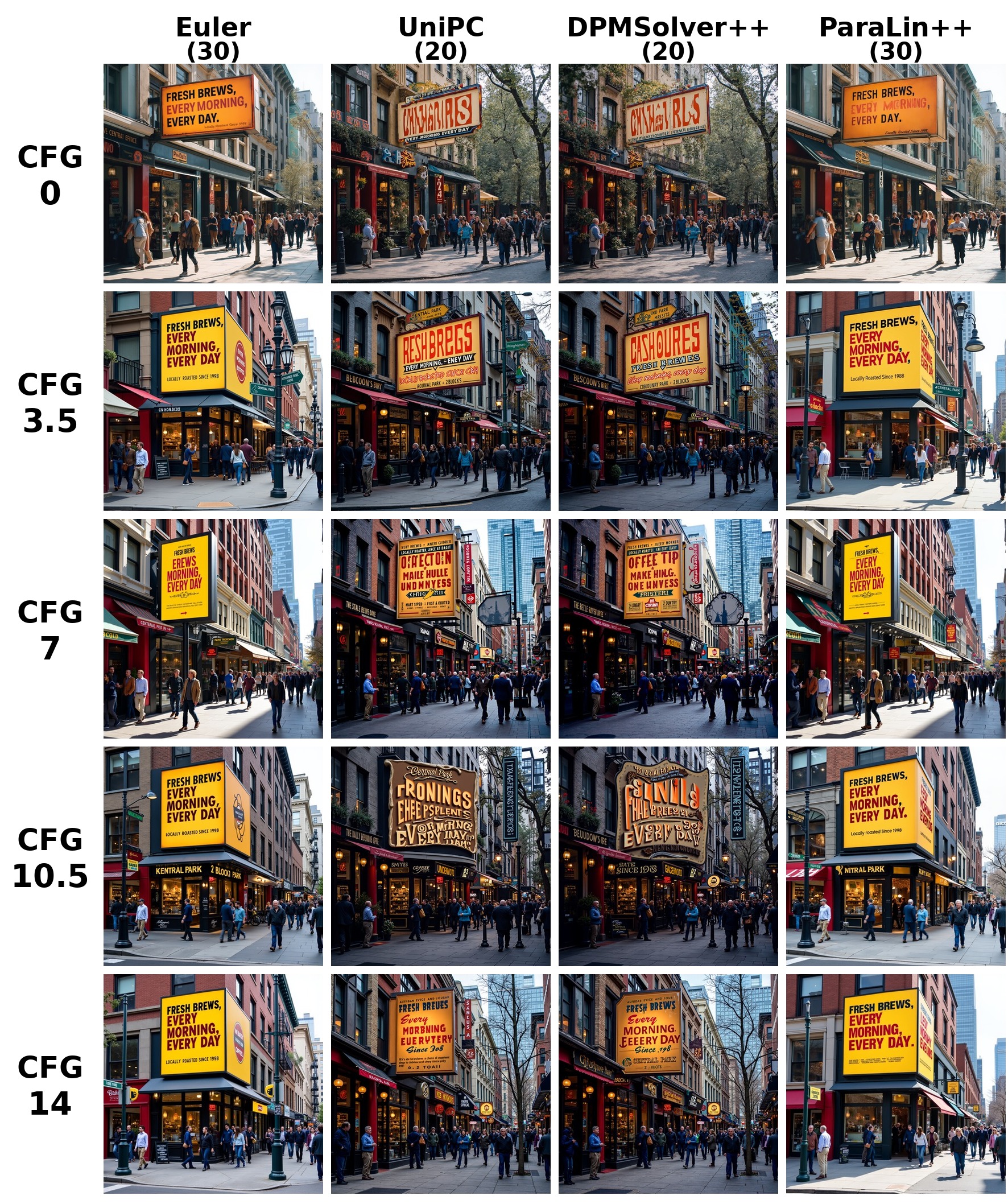
LongTextBench CFG sweep on FLUX.1-dev, using an English prompt; the reported metric averages the English and Chinese subsets.
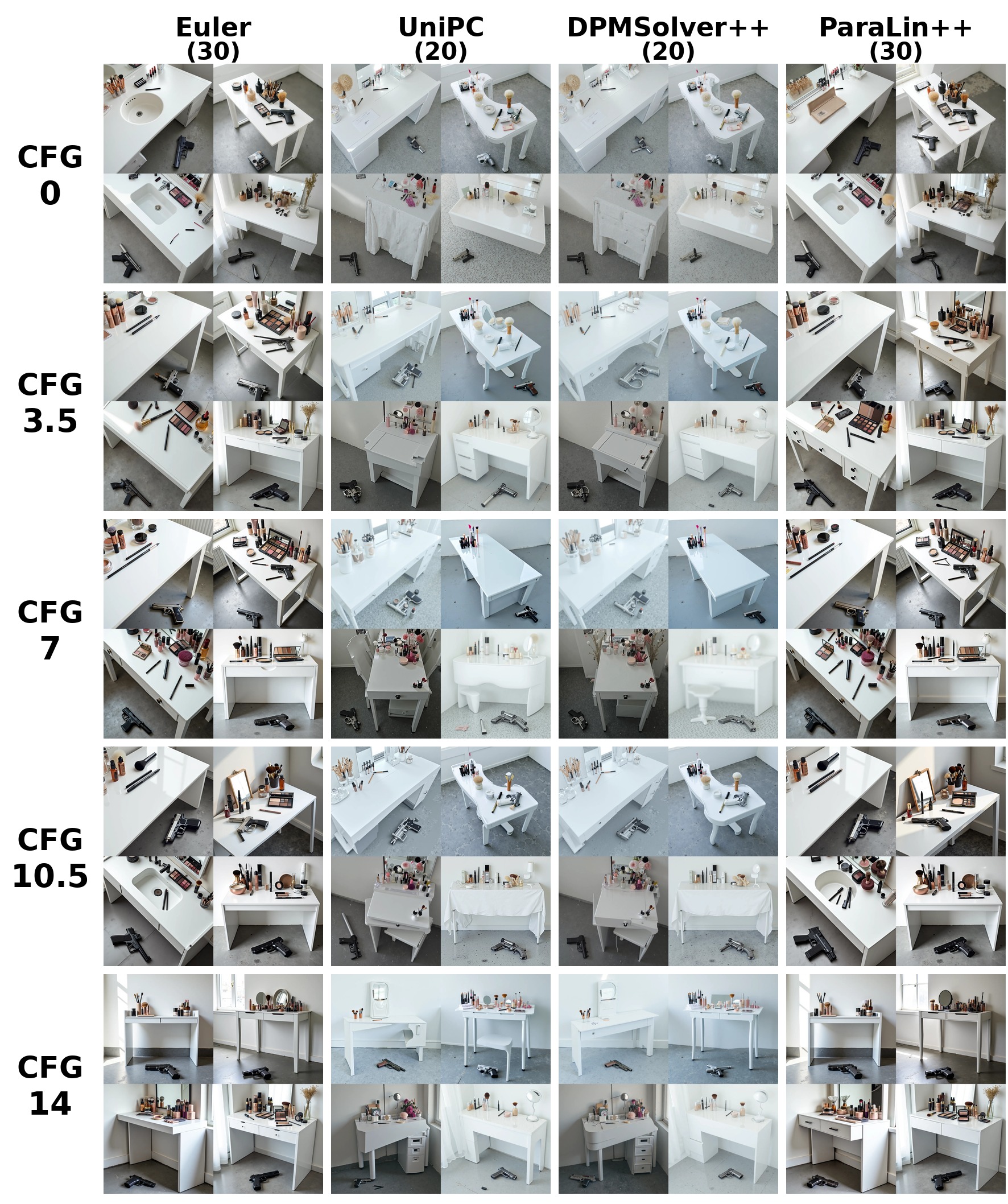
DPG-Bench CFG sweep on FLUX.1-dev: as guidance rises, 20-step UniPC / DPMSolver++ drop objects and flatten scene structure, while step-parity ParaLin++ stays aligned with the 30-step Euler reference at every guidance setting.
The Problem with Few-Step Solvers
Step-shortening solvers (DDIM, DPMSolver++, UniPC) buy fewer discrete steps by altering the prompt-conditioned trajectory — and the altered trajectory is exactly what breaks dense-prompt and text fidelity; FID merely fails to reflect this break because it overlooks sample-level semantics. Parallel sampling instead keeps all N discrete steps and removes only the solver's temporal dependency. We call this the step-parity route, and ParaLin++ is a direct realization of this step-parity route.
Our Solution: ParaLin++
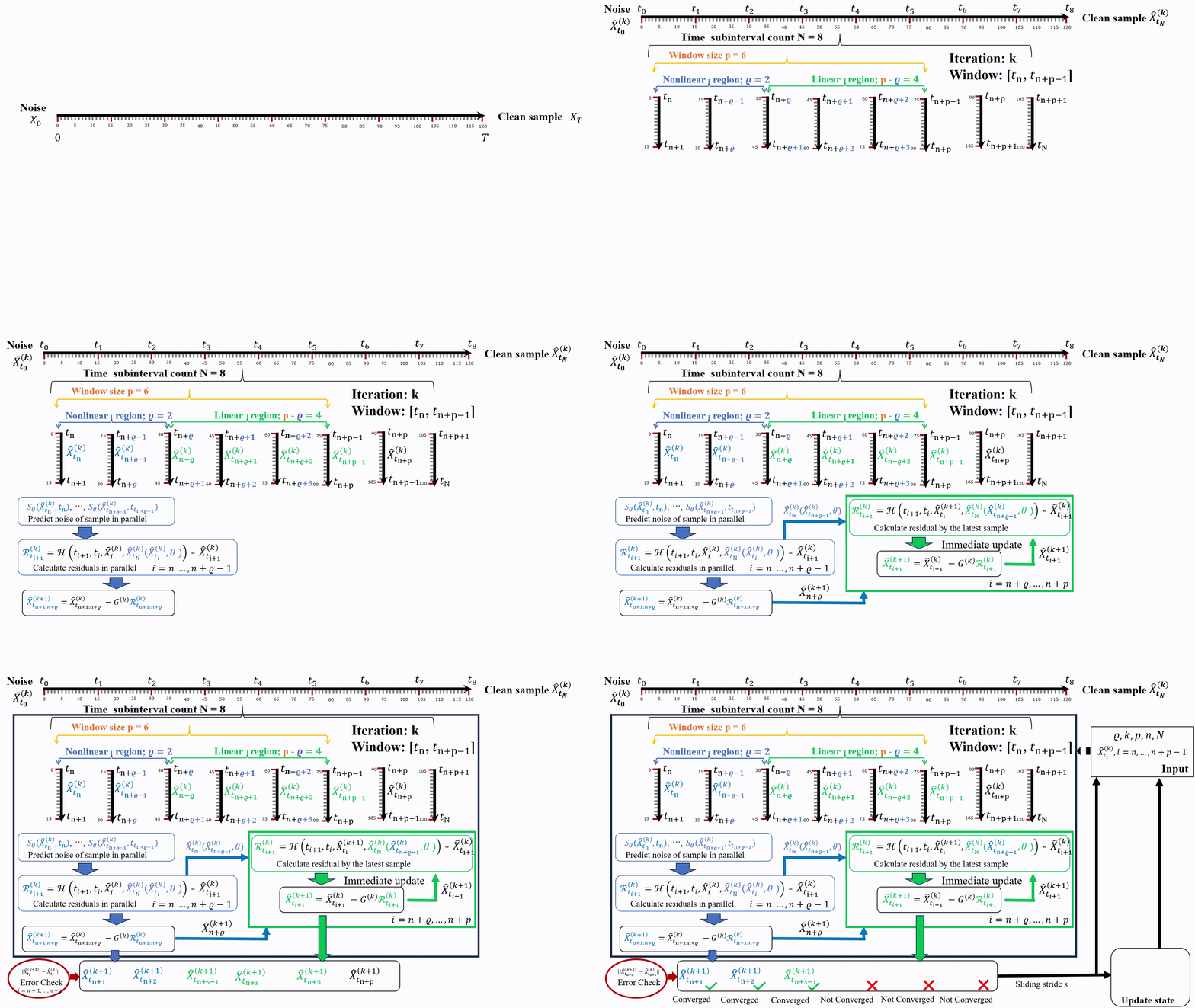
ParaLin++ reinterprets sequential sampling as a mixed system of linear and nonlinear equations and solves it in parallel. It combines four components:
Adaptive Nonlinearization (ϱ-nonlinear system)
Only the first ϱ blocks stay nonlinear; the rest become linear with reused clean-sample predictions, drastically cutting NFE.
Successive Over-Relaxation
Provably stable for 0 < ω < 2/(1+L), accelerating contraction of both nonlinear and linear blocks.
Sliding Window
Bounds the working set for long sampling trajectories.
Adaptive Stopping
A relative historical-error test with an exponential moving average terminates iterations precisely.
Theory: an accumulated error bound relative to the exact sequential trajectory, and convergence of the iteration to the ϱ-nonlinear surrogate system within K ≤ N iterations.
How It Works: The Partially Linear Pipeline
Instead of treating all steps as computationally expensive nonlinear operations, our method linearizes most of the sampling process. As shown in the pipeline below, only a small number of steps (the "Nonlinear Region" ϱ) require full model evaluations. The remaining steps ("Linear Region") are solved with a highly efficient linear solver, dramatically reducing NFE and unleashing parallel efficiency.
Preserving Quality: Intermediate Step Comparison
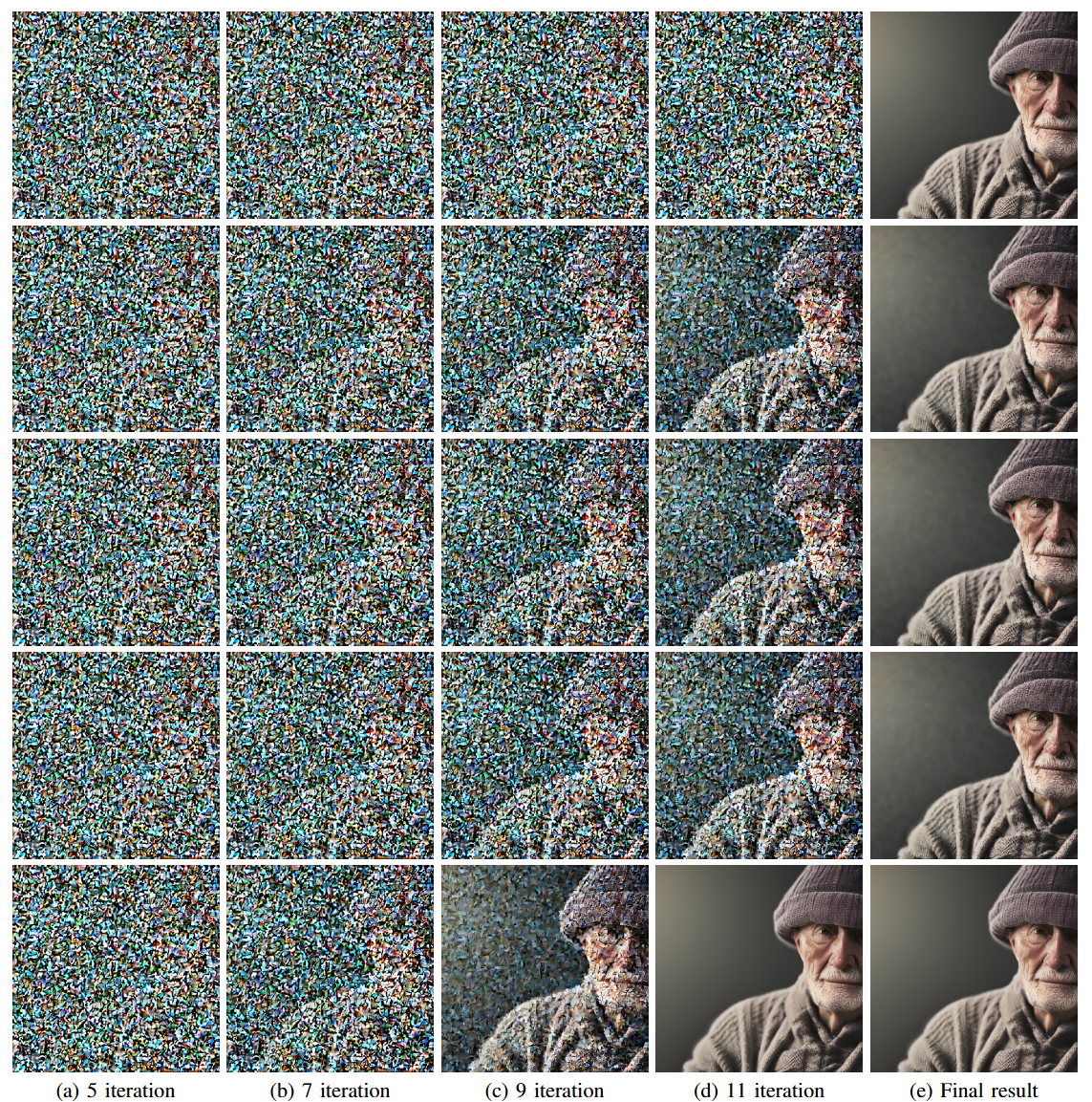
Our method converges to a high-fidelity image in significantly fewer iterations, demonstrating efficiency without sacrificing quality.
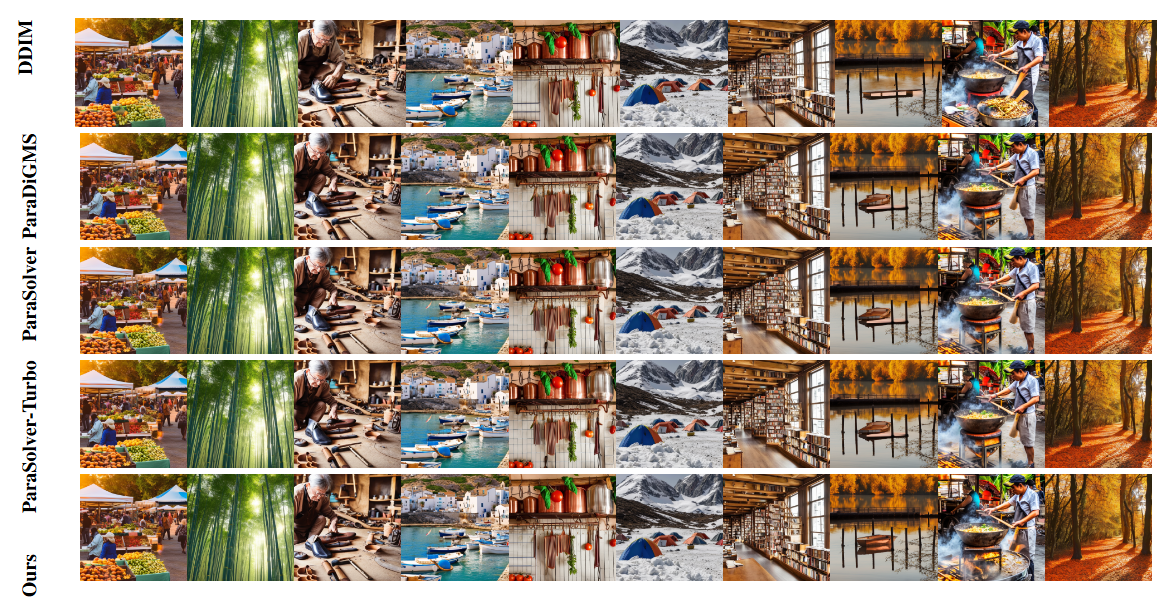
Comparison 1: Expediting DDIM (50 steps).
The rows, from top to bottom, represent DDIM, ParaDiGMS, ParaSolver, ParaLin, and ParaLin++ (the last two shown under their former ParaSolver-Turbo-series names).
Comparison 2: Visual comparison of samplers (50-step DDIM baseline)
Quantitative Results
ParaLin++ substantially reduces wall-clock latency while preserving generation quality. On Stable Diffusion-v2 (classifier guidance w = 7.5) and LSUN Church (5000 samples), it consistently achieves the lowest wall-clock time and iteration counts, with negligible change in FID or CLIP scores, even on a single GPU.
Stable Diffusion-v2
| Steps | Method | Iters ↓ | NFE ↓ | CLIP ↑ | FID ↓ | Time (s) ↓ | Speedup ↑ |
|---|---|---|---|---|---|---|---|
| 50 | DDIM | 50 | 50 | 25.6 | 57.2 | 6.3 | 1.0× |
| DDIM + ParaDiGMS | 21 | 132 | 25.6 | 56.9 | 3.3 | 1.9× | |
| DDIM + ParaSolver | 13 | 83 | 25.6 | 56.9 | 1.9 | 3.3× | |
| DDIM + ParaLin | 13 | 73 | 25.6 | 57.1 | 1.7 | 3.7× | |
| DDIM + ParaLin++ | 10 | 69 | 25.5 | 57.0 | 1.3 | 4.8× | |
| 25 | DDIM | 25 | 25 | 25.4 | 62.9 | 3.4 | 1.0× |
| DDIM + ParaDiGMS | 18 | 53 | 25.4 | 62.8 | 3.2 | 1.2× | |
| DDIM + ParaSolver | 11 | 49 | 25.4 | 61.9 | 1.6 | 2.1× | |
| DDIM + ParaLin | 11 | 42 | 25.4 | 61.8 | 1.55 | 2.2× | |
| DDIM + ParaLin++ | 9 | 40 | 25.4 | 61.9 | 1.3 | 2.6× | |
| 50 | DPMSolver | 50 | 50 | 25.6 | 57.2 | 6.3 | 1.0× |
| DPMSolver + ParaDiGMS | 25 | 132 | 25.6 | 57.2 | 3.3 | 1.8× | |
| DPMSolver + ParaSolver | 15 | 96 | 25.6 | 57.1 | 2.2 | 3.1× | |
| DPMSolver + ParaLin | 14 | 93 | 25.6 | 57.1 | 1.9 | 3.3× | |
| DPMSolver + ParaLin++ | 10 | 77 | 25.6 | 57.1 | 1.35 | 4.7× | |
| 25 | DPMSolver | 25 | 25 | 25.4 | 62.3 | 3.2 | 1.0× |
| DPMSolver + ParaDiGMS | 15 | 81 | 25.4 | 62.3 | 2.2 | 1.5× | |
| DPMSolver + ParaSolver | 11 | 58 | 25.4 | 62.2 | 1.5 | 2.1× | |
| DPMSolver + ParaLin | 10 | 55 | 25.4 | 62.1 | 1.4 | 2.3× | |
| DPMSolver + ParaLin++ | 8 | 46 | 25.4 | 62.1 | 1.1 | 2.9× |
LSUN Church (5000 samples)
| Steps | Method | Iters ↓ | NFE ↓ | FID ↓ | Time (s) ↓ | Speedup ↑ |
|---|---|---|---|---|---|---|
| 50 | DDIM | 50 | 50 | 15.5 | 1.8 | 1.0× |
| DDIM + ParaDiGMS | 23 | 202 | 15.8 | 1.5 | 1.2× | |
| DDIM + ParaSolver | 14 | 73 | 15.7 | 0.8 | 2.2× | |
| DDIM + ParaLin | 14 | 67 | 15.7 | 0.6 | 3.0× | |
| DDIM + ParaLin++ | 9 | 64 | 15.7 | 0.4 | 4.5× | |
| 25 | DDIM | 25 | 25 | 15.6 | 1.1 | 1.0× |
| DDIM + ParaDiGMS | 15 | 96 | 15.7 | 0.8 | 1.4× | |
| DDIM + ParaSolver | 10 | 44 | 15.7 | 0.5 | 2.2× | |
| DDIM + ParaLin | 10 | 39 | 15.7 | 0.45 | 2.4× | |
| DDIM + ParaLin++ | 8 | 33 | 15.7 | 0.36 | 3.1× |
Citation
@article{lu2026paralinpp,
  title   = {ParaLin++: Accelerating Parallel Diffusion Integrator
             via Intrinsic Partially Linear Structure},
  author  = {Lu, Jianrong and Zhu, Zhiyu and Liu, Hui and Hou, Junhui},
  journal = {Manuscript under Review},
  year    = {2026}
}